
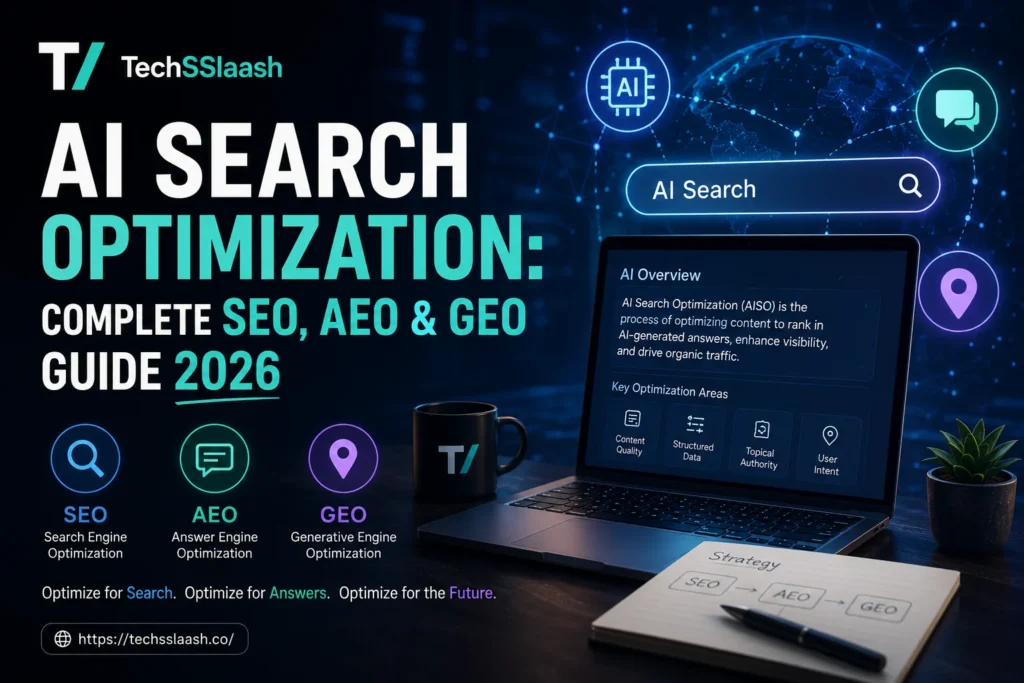
AI Search Optimization: The Complete Guide to SEO, AEO & GEO in 2026
Search is changing faster than it has in years. People are no longer relying only on traditional blue links to find information. Google’s AI Overviews, AI Mode, conversational search, and other AI-powered search experiences are changing how users discover websites, brands, products, and answers.
This shift has created a new area of digital marketing known as AI search optimization.
AI search optimization focuses on making websites and content easier for AI-powered search systems to understand, evaluate, summarize, and potentially cite. It does not replace traditional SEO. Instead, it builds on strong SEO fundamentals while adapting content for the way AI search experiences process information.
In this guide, we will explain what AI search optimization means, how it relates to SEO, AEO, and GEO, and practical ways businesses can improve their visibility across modern AI search results.
What Is AI Search Optimization?
AI search optimization is the process of improving a website’s content, structure, authority, and accessibility so that AI-powered search systems can better understand and use its information.
Traditional SEO primarily focuses on improving visibility in search engine results pages. AI search introduces another layer because systems may generate direct answers by combining information from multiple sources.
This means your goal is no longer simply to rank for a keyword.
You also want your content to be:
- Easy for search engines and AI systems to understand
- Directly relevant to search intent
- Factually accurate
- Well structured
- Supported by credible information
- Useful enough to be referenced or cited
- Connected to a clear topic and entity
A successful AI search optimization strategy therefore combines traditional SEO with content quality, topical authority, structured information, and clear answers.
Why AI Search Optimization Matters in 2026
Google’s search experience increasingly includes AI-generated responses for suitable queries. Users can sometimes receive a synthesized answer before interacting with traditional organic results.
This changes the search journey.
Someone searching for:
“What is the best way to optimize an e-commerce website for AI search?”
may receive an AI-generated overview that summarizes information from several websites.
The websites referenced in that answer can gain valuable visibility even if the user does not initially interact with a traditional blue-link result.
This makes AI search visibility an increasingly important consideration for publishers, businesses, and marketers.
However, AI search does not mean traditional SEO is dead.
Strong technical SEO, useful content, internal linking, crawlability, authority, and search intent remain important foundations. AI search optimization should therefore be treated as an extension of SEO rather than a replacement for it.
Google AI Overviews SEO: What You Need to Know
One of the biggest developments in modern search is Google’s AI Overviews.
AI Overviews can provide an AI-generated summary for certain searches and may include links to websites that support the information presented.
This has created significant interest in Google AI Overviews SEO.
Many marketers ask:
How do I get my website featured in Google AI Overviews?
There is no guaranteed formula for inclusion. Google determines which information is useful and relevant for each query.
Instead of trying to manipulate AI Overviews, focus on creating content that clearly answers the user’s question and provides information worth referencing.
Ways to improve your chances of AI Overview Visibility includes:
- Create genuinely useful content.
- Answer important questions directly.
- Demonstrate expertise and credibility.
- Build topical authority.
- Organize information using clear headings.
- Support important claims with trustworthy sources.
- Keep information accurate and current.
- Make your website easy for search engines to crawl.
- Use descriptive titles and headings.
- Build a strong overall website reputation.
The same principle applies to broader AI Overviews SEO: optimize for users first and make your information easy for search systems to understand.
How to Optimize Content for AI Search
If you want to optimize content for AI search, start by improving the fundamentals of the content itself.
AI systems need to understand what a page is about, which questions it answers, and whether the information appears reliable.
1. Answer the Main Question Quickly
Don’t make readers go through 1,000 words before discovering the actual answer.
Start important sections with a clear explanation.
For example, if your heading is:
What Is AI Search Optimization?
The first paragraph should immediately define the term.
You can then provide examples, benefits, strategies, and supporting information afterward.
2. Use Clear Content Structure
Use descriptive H2 and H3 headings to divide information into logical sections.
For example:
- What Is AI Search Optimization?
- Why Does AI Search Matter?
- How Google AI Overviews Work
- AI Search vs. Traditional SEO
- How to Optimize Content for AI Search
- Common AI SEO Mistakes
This structure makes long-form content easier for both users and search systems to understand.
3. Cover the Topic Comprehensively
A page should not answer only one tiny part of a broad topic when a comprehensive resource would be more useful.
For example, an article about AI search optimization could cover:
- AI Overviews
- AI Mode
- AEO
- GEO
- SEO
- citations
- topical authority
- content structure
- technical SEO
- brand authority
- measurement
This creates a stronger topical resource.
How Google AI Overviews Choose Sources
There is no publicly available checklist that guarantees a website will become an AI overview source.
Instead, Google’s systems determine which information is useful for a particular search.
This is why marketers should avoid tactics promising guaranteed AI overview placements.
A stronger approach is to build content that demonstrates:
Relevance + Quality + Expertise + Clarity + Authority
Your content should provide information that directly contributes to answering the user’s query.
For competitive subjects, this may also require building authority across the broader topic rather than publishing one isolated article.
AI Overviews vs Traditional Google Search
Traditional search generally presents a collection of results that users can visit and evaluate.
AI-powered search can instead synthesize information from multiple sources into a conversational response.
This creates a major difference in visibility.
With traditional SEO, you may focus heavily on:
- Rankings
- Organic clicks
- Impressions
- CTR
With AI search, marketers also need to consider:
- Citations
- Brand mentions
- AI-generated recommendations
- Visibility within AI answers
- Entity recognition
- Referral traffic from AI platforms
This does not mean traditional metrics are irrelevant. It means businesses need a broader definition of search visibility.
SEO vs AEO vs GEO
Three terms frequently appear in discussions about AI search: SEO, AEO, and GEO.
SEO
Search engine optimization focuses on improving a website’s visibility in traditional search engines.
AEO
Answer Engine Optimization focuses on creating content that directly answers questions and can be surfaced by answer-oriented search experiences.
GEO
Generative engine optimization generally refers to optimizing content and brand presence for generative AI systems that produce synthesized answers.
SEO vs AEO vs GEO
These approaches overlap significantly.
You don’t necessarily need three completely different strategies.
A strong modern strategy can combine all three:
SEO → Discoverability
AEO → Direct Answers
GEO → Generative Search Visibility
This is why SEO vs AEO vs GEO should not be viewed as a competition where one replaces another.
How to Make Your Content Citable by AI Search Engines
One of the biggest goals of AI search optimization is making your information useful enough to be referenced.
To create potentially citable content:
Provide Original Information
Original research, data, examples, analysis, and expert insights can make content more valuable than generic summaries.
Be Specific
Avoid vague statements when you can provide useful details, examples, or explanations.
Support Important Claims
Use credible sources where appropriate, particularly when discussing statistics, research, regulations or technical claims.
Establish Clear Expertise
Show readers who created the content and why that person or organization is qualified to discuss the subject.
Keep Information Updated
Outdated information can reduce the usefulness of a page, especially in rapidly changing industries.
How to Build Topical Authority for AI Search
Publishing one article about AI does not necessarily make a website authoritative on artificial intelligence.
Instead, create connected content around a central subject.
For example, Techsslaash.net could build an AI search cluster around:
- AI Search Optimization
- Google AI Overviews
- Google AI Mode
- AEO
- GEO
- ChatGPT Search
- AI citations
- AI search visibility
- AI search analytics
- AI search for e-commerce
- AI search for local businesses
Then connect these pages using relevant internal links.
This helps create a clear topical relationship between your content.
Topical authority is therefore an important part of a long-term AI search optimization strategy.
How to Optimize for Google AI Mode
Google AI Mode provides a more conversational search experience where users can ask complex questions and explore a topic through follow-up interactions.
To prepare content for Google AI Mode, focus on comprehensive resources rather than pages designed around one exact keyword.
Think about the questions a user may ask next.
For example, someone searching:
“How can I improve e-commerce SEO?”
may continue asking:
- Does structured data help?
- How should I optimize product pages?
- What about product reviews?
- How does AI search affect e-commerce?
- How can I measure results?
A strong resource anticipates these related questions and provides useful answers.
AI Search Optimization for Small Businesses
Small businesses can also benefit from AI search.
A local restaurant, agency, ecommerce store, hotel, or service provider should make sure its online information is accurate and consistent.
Important areas include:
- Business name
- Website
- Services
- Location
- Contact information
- Reviews
- Business profiles
- About information
- Authoritative mentions
- Relevant local content
Businesses should also publish useful content answering the questions their customers commonly ask.
For example, a Dubai tourism company could publish detailed guides about desert activities, tour options, prices, timing, safety, and booking considerations instead of relying only on commercial landing pages.
This creates useful informational content that can support both traditional SEO and AI search visibility.
How Brands Can Appear in AI Search Results
Brand visibility is becoming another important part of AI search.
If someone asks an AI search system:
“What are the best SEO tools for small businesses?”
the answer may include multiple brands.
For your brand to be considered, search systems need to understand what the company is, what it offers and how it relates to the topic.
Build a consistent digital presence across:
- Your official website
- About page
- Organization information
- Social profiles
- Industry publications
- Reviews
- Relevant directories
- Digital PR
- Expert mentions
- Third-party websites
The goal is to create a consistent and trustworthy brand entity across the web.
How to Measure AI Search Visibility
AI search visibility is still developing, so traditional SEO tools may not capture every appearance.
Businesses should monitor several signals.
Traditional Search Metrics
Continue tracking:
- Organic traffic
- Rankings
- Impressions
- CTR
- Conversions
AI Search Signals
Where data is available, also monitor:
- AI-generated citations
- Brand mentions
- Referral traffic from AI platforms
- AI search visibility
- Changes in branded searches
- Mentions across relevant AI platforms
Don’t focus only on whether your page appeared once.
Look for broader improvements in brand visibility and qualified traffic.
Common AI Search Optimization Mistakes
Avoid treating AI search like a shortcut around SEO.
Keyword Stuffing
Repeating “AI search optimization” dozens of times doesn’t make content more useful.
Creating Low-Quality AI Content
Publishing large amounts of generic AI-generated content without adding expertise or value can weaken the overall quality of a website.
Ignoring Technical SEO
AI search still depends on accessible, discoverable web content.
Chasing Every New Acronym
SEO, AEO and GEO overlap considerably. Don’t create unnecessary pages simply because a new marketing term becomes popular.
Forgetting the User
The best AI search strategy is still based on answering real questions better than competing content.
The Future of SEO in the Age of AI Search
The future of SEO is unlikely to be about choosing between traditional search and AI search.
Instead, search optimization will increasingly involve multiple discovery surfaces.
Users may discover a company through:
- Traditional Google results
- AI Overviews
- AI Mode
- Conversational search
- AI assistants
- Product recommendations
- Local recommendations
- Social platforms
This means brands need a broader digital visibility strategy.
The websites most likely to benefit will be those that consistently publish useful information, establish real expertise, maintain strong technical foundations, and build recognizable brands.
Final Thoughts
AI search optimization is becoming an important part of modern digital marketing, but it should not be treated as a replacement for SEO.
The strongest approach combines traditional SEO with clear answers, comprehensive content, topical authority, strong brand signals, and information that AI systems can understand and potentially reference.
Whether you are trying to improve Google AI Overviews SEO, prepare for Google AI Mode, build a GEO strategy, improve AEO, or increase your brand’s AI search visibility, the foundation remains the same: create useful content for real users and make that information easy to discover, understand, and trust.
For businesses and publishers, the opportunity is significant. Search is evolving, and the brands that start adapting now can build stronger visibility across both traditional and AI-powered search experiences.
Start with strong SEO. Build topical authority. Create genuinely useful answers. Then optimize for the AI-powered search ecosystem.