
Technology is changing quickly, and websites increasingly rely on embedded content, interactive widgets, social integrations, APIs, and other third-party tools to improve the user experience. For website owners and developers, knowing how to implement these technologies correctly can make a major difference in performance and usability. This is where Embedtree Tech Tips can be useful.
Embedtree focuses on technology-related information, including practical guidance around software, digital tools, integrations, performance, and other technology topics. Its Tech Tips & Tricks content is designed to help users understand technical concepts and apply them to real-world projects.
But how useful are these resources? What exactly is Embedtree, how does it work, and what should users know before implementing embedded content or related technologies?
In this Embedtree review, we will look at Embedtree features, setup, performance optimization, APIs, webhooks, custom styling, troubleshooting, security considerations, alternatives, and practical Embedtree tech tips and tricks.
Rather than treating Embedtree as a solution for every website, this guide takes a balanced approach. Some features and techniques can be particularly useful for developers and website owners, while others may require more technical knowledge.
Whether you are searching for an Embedtree tutorial, trying to understand how to use Embedtree, or simply researching whether it is worth exploring, this guide covers the main points you should know.
What Is Embedtree?
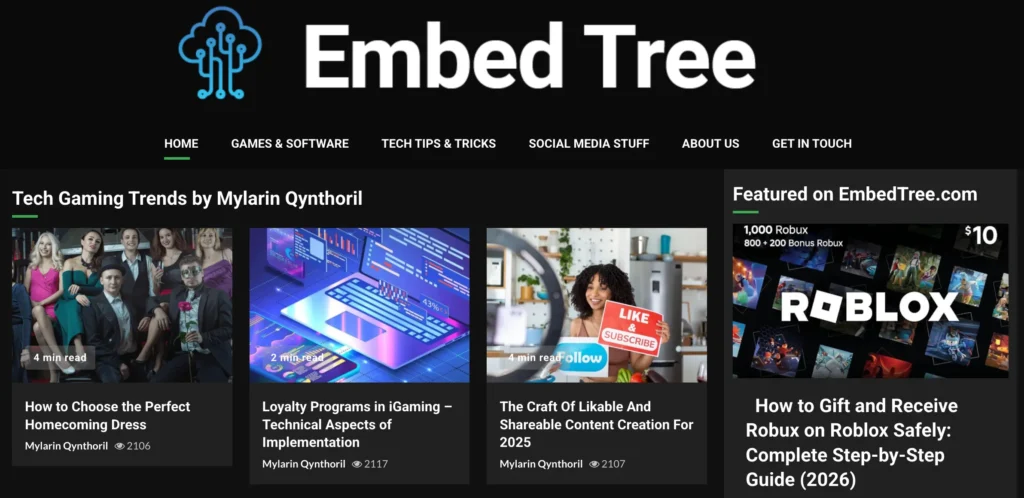
Embedtree is a technology-focused website that publishes content covering different areas of digital technology. Its subject areas include technology tips and tricks, software, games, social media, IT tools, and other digital topics.
The official website describes its content around games and software, social media, technology tips and tricks, IT tools, and related subjects. Its dedicated Tech Tips & Tricks section includes practical topics involving setup, performance optimization, APIs, webhooks, custom styling, and troubleshooting.
For readers, this makes Embedtree more of an informational technology resource than a single-purpose software platform.
The term “Embedtree” can sometimes create confusion because search results may also contain discussions about embedding tools, widgets, and content integrations. Therefore, it is important to understand the context when researching Embedtree technology or Embedtree tools.
The website’s technology content is particularly relevant for people who want practical advice rather than purely theoretical explanations.
What Does Embedtree Actually Do?

At its core, Embedtree provides technology-related information and practical guidance.
The Embedtree Tech Tips section can be useful for understanding concepts such as
- Website integrations
- Embedded content
- Performance optimization
- APIs
- Webhooks
- Custom styling
- Responsive design
- Troubleshooting
- Software and digital tools
For beginners, this type of content can provide a starting point for learning. More experienced developers can also use technology guides as references when evaluating implementation approaches.
However, readers should always verify technical details against official documentation when working with a specific software product, API, or third-party service.
Embedtree Tech Tips – What Are They?
The phrase Embedtree Tech Tips primarily refers to practical technology advice and educational content associated with Embedtree’s technology section.
Unlike generic technology news, practical tech tips focus on solving specific problems.
For example, a website owner may want to improve loading speed after adding several widgets. A developer may need to understand how an API should be integrated. Another user may want to customize the appearance of embedded content without affecting the rest of a website.
These are the types of practical problems that technology tips can help address.
The official Tech Tips & Tricks content discusses areas such as setup, speed optimization, APIs, webhooks, custom styling, and version management, making these topics particularly relevant when researching Embedtree tech tips and tricks.
One of the biggest advantages of practical guides is that they connect technical concepts with real-world use cases.
Instead of simply explaining what an API is, for example, a good guide can explain why an API matters, what security precautions are necessary, and how poor implementation could affect a website.
Key Features of Embedtree
When researching Embedtree features, it is useful to look at both the site’s technology content and the types of technical concepts it discusses.
Interactive Content
Interactive content can make websites more engaging than static text alone.
Examples include:
- Interactive widgets
- Embedded media
- Social feeds
- Forms
- Dynamic content
- External tools
However, interactive elements should be implemented carefully. Every additional third-party resource can potentially introduce extra JavaScript, network requests, or rendering work.
That is why performance should always be considered alongside functionality.
Customization
Customization is another important area covered by technology-focused Embedtree content.
Website owners may want embedded elements to match their existing branding, including:
- Typography
- Spacing
- Layout
- Width
- Height
- Responsive behavior
- Visual appearance
Good Embedtree custom styling practices can help prevent an embedded component from looking disconnected from the rest of the website.
CSS should generally be scoped carefully so that styling an embedded component does not accidentally modify unrelated elements on the page.
Analytics and Tracking
Analytics can help website owners understand whether users interact with embedded content.
Depending on the technology being used, tracking can potentially provide information about:
- Clicks
- Engagement
- Interactions
- Page performance
- Conversion behavior
However, analytics implementations should be transparent and should respect applicable privacy requirements.
Social Media Integration
Social media integration is another common use case for modern websites.
A website may embed social content or connect social profiles to create a centralized experience for visitors.
This can be useful for businesses, creators, publishers, and organizations that want visitors to discover their social channels without leaving the website.
At the same time, third-party social embeds can affect page speed, so they should be implemented selectively.
Widgets
Widgets are small components that provide specific functionality within a webpage.
Examples include:
- Social widgets
- Content widgets
- Interactive tools
- Forms
- Media players
- Analytics components
When using Embedtree widgets or similar third-party components, website owners should test how they behave on both desktop and mobile devices.
How Does Embedtree Work?
Understanding how to use Embedtree depends on the particular technology, content, or integration being discussed.
For a typical embedded-content workflow, the process can be divided into several stages.
Step 1 – Choose Your Content
First, determine what you actually need to embed.
Don’t add a widget simply because it is available. Ask whether it provides meaningful value to visitors.
For example, an interactive tool that helps visitors understand a product may provide genuine value, while several unnecessary social feeds could simply make the page slower.
Step 2 – Prepare the Embed
The next step is preparing the content or component for integration.
Depending on the technology, this might involve:
- An embed code
- JavaScript
- HTML
- An API
- A widget configuration
- A third-party integration
Always follow the relevant provider’s documentation.
Step 3 – Add Embedtree to Your Page
Once the content is prepared, it can be added to the relevant website page.
Developers should preferably test the implementation on a staging environment before deploying it to a live website.
Step 4 – Customize the Design
After adding the component, check its visual appearance.
Pay attention to:
- Width
- Height
- Margins
- Padding
- Typography
- Mobile responsiveness
- Alignment
Step 5 – Test Before Publishing
Testing is an essential part of the Embedtree setup process.
Check the integration on:
- Desktop
- Mobile
- Different browsers
- Different screen sizes
- Slower connections
Also check whether the embedded content causes layout shifts or delays page rendering.
Embedtree Setup Guide for Beginners
For beginners, the best approach is to keep the initial implementation simple.
Start with one page and one embedded component rather than adding multiple technologies at once.
A basic Embedtree tutorial workflow can look like this:
- Choose the content you want to integrate.
- Review the relevant documentation.
- Create a test page.
- Add the required embed or integration.
- Configure responsive behavior.
- Check the appearance.
- Test loading performance.
- Review mobile compatibility.
- Fix any errors.
- Publish after testing.
The official technology guidance emphasizes testing on a staging page, responsive behavior, lazy loading for non-critical elements, HTTPS, and having a rollback approach.
This is a sensible approach for almost any website integration.
A common mistake is to install an embedded component directly on a high-traffic page without testing it first.
If the integration creates a JavaScript error or slows down the page, troubleshooting becomes more complicated.
Starting with a staging environment gives developers an opportunity to identify problems before visitors encounter them.
Embedtree Performance – How to Make It Faster
One of the most important areas when discussing Embedtree performance is the impact of third-party content.
An embedded component may require additional:
- JavaScript
- CSS
- Images
- Network requests
- API calls
- External resources
Each additional resource can potentially increase loading time.
Use Lazy Loading
Lazy loading can prevent non-critical content from loading before it is needed.
For example, if an embedded widget appears far below the initial viewport, there may be little reason to load all of its resources immediately.
Lazy loading can therefore improve the initial page experience.
Defer JavaScript
JavaScript that is not required immediately can often be deferred.
Using appropriate loading strategies can allow important page content to become interactive sooner.
However, developers should test dependencies before changing script-loading behavior.
Optimize Images
Large images can negatively affect website performance.
Use appropriately sized images and modern formats when supported.
Avoid loading a 2,000-pixel image when the visitor only needs a small thumbnail.
Use Caching
Caching can reduce repeated network requests and improve loading times for returning visitors.
Depending on your website architecture, caching can be implemented at different levels, including browser, server, CDN, or application level.
Reduce DOM Complexity
A page containing too many unnecessary elements can become more expensive for the browser to render.
Keep embedded components as lightweight as possible and avoid adding several unnecessary widgets to the same page.
Monitor Core Web Vitals
Website owners should also monitor Core Web Vitals.
Important metrics include:
- LCP
- INP
- CLS
These measurements provide useful information about loading, responsiveness, and visual stability.
The official Embedtree technology guidance similarly recommends techniques such as deferring non-essential JavaScript, compressing assets, caching, and reducing unnecessary DOM elements.
Embedtree API and Advanced Integrations
For developers, Embedtree API and integration concepts can be particularly interesting.
An API allows different software systems to communicate with one another.
Instead of manually transferring information between applications, an API can provide a structured way for one system to request or send data.
API Integration
When implementing an Embedtree integration, developers should first understand:
- Authentication
- Endpoints
- Request methods
- Parameters
- Responses
- Error handling
- Rate limits
API documentation should always be treated as the primary source for exact implementation details.
Webhooks
Webhooks work differently from traditional API requests.
Rather than repeatedly asking a service whether something happened, a webhook can notify another system when a specific event occurs.
For example, a system might send an event notification when content changes or an action is completed.
Security
API security should never be overlooked.
Useful practices include:
- Scoped API keys
- Token rotation
- HTTPS
- Server-side authentication
- Secure secret storage
- Webhook signature validation
Never expose sensitive API credentials directly inside publicly accessible frontend code unless the architecture specifically requires it and the credentials are designed for public use.
Error Handling
Reliable integrations also need proper error handling.
Developers should plan for:
- Failed requests
- Timeout errors
- Invalid credentials
- Rate limits
- Server errors
- Missing data
Logging and monitoring can make troubleshooting considerably easier.
Embedtree Custom Styling Tips
Good design matters as much as functionality.
An embedded component that technically works but looks broken on mobile can still create a poor user experience.
When working with Embedtree custom styling, avoid global CSS rules that could affect unrelated parts of the website.
Scoped classes and variables can make styling safer.
For example, instead of targeting generic elements such as every h2 or div, use component-specific classes.
This approach reduces the risk of conflicts with the site’s existing theme.
Responsive design should also be a priority.
A component that looks perfect on a 27-inch desktop monitor may overflow horizontally on a smartphone.
Test different viewport widths and make sure:
- Text remains readable
- Buttons are accessible
- Images scale properly
- Content does not overflow
- Horizontal scrolling is avoided
Embedtree Tech Tips for Better User Experience
Technical implementation should always support the visitor rather than making the website more complicated.
Think Mobile First
A large percentage of web traffic comes from mobile devices.
Every embedded component should therefore be tested on smartphones and tablets.
Keep Pages Lightweight
More functionality isn’t automatically better.
If five widgets provide little additional value, removing three of them may improve the overall experience.
Create a Clear Content Hierarchy
Important content should appear before secondary interactive elements.
Visitors should understand the purpose of the page without waiting for several external resources to load.
Avoid Unnecessary Animation
Animations can improve an interface when used carefully, but excessive motion can distract users and increase performance costs.
Test Real Devices
Browser developer tools are useful, but testing on real devices can reveal issues that don’t appear in desktop simulations.
Is Embedtree Safe and Reliable?
One of the questions users may ask is “Is Embedtree safe?”
Safety should be considered from several angles.
First, websites should use HTTPS when handling information or loading third-party resources.
Second, developers should protect API credentials and avoid exposing sensitive secrets.
Third, third-party content should be evaluated before being added to a production website.
A website owner should know:
- Where the content comes from
- What scripts are loaded
- What data is transmitted
- Whether external services are involved
- How updates are handled
- What happens if the external service becomes unavailable
The official Embedtree technology guidance discusses security practices including HTTPS, scoped credentials, token rotation, and webhook validation.
However, no integration should automatically be considered “100% secure.”
Security depends on implementation.
A poorly configured integration can create risks even when the underlying technology is reputable.
Embedtree Pros and Cons
A balanced Embedtree review should consider both advantages and limitations.
| Pros | Cons |
| Practical technology information | Some topics may require technical knowledge |
| Useful tech tips and tricks | Beginners may need additional documentation |
| Performance-focused guidance | Third-party embeds can affect speed |
| Covers APIs and integrations | Advanced implementation requires development skills |
| Custom styling concepts | CSS conflicts can occur |
| Responsive design guidance | Too many embeds can hurt UX |
| Troubleshooting information | Exact functionality depends on the technology involved |
The biggest advantage is the practical nature of the content.
The biggest limitation is that technical recommendations cannot always be applied identically to every website.
Embedtree Problems & Troubleshooting
Even a properly planned integration can encounter problems.
Understanding common Embedtree problems can make troubleshooting easier.
Embed Not Loading
If embedded content does not appear, check:
- Embed code
- JavaScript errors
- Network requests
- HTTPS
- Third-party resource availability
- Browser console messages
An incorrect URL or script can prevent an embedded component from loading.
Embed Looks Broken on Mobile
If the component works on desktop but not mobile, examine its width and height settings.
Also check whether a fixed-width element is causing horizontal overflow.
Slow Loading
If the page becomes slow after adding an embed, use browser performance tools to identify expensive requests.
Check:
- JavaScript
- Images
- External resources
- API calls
- Number of widgets
Removing unnecessary third-party components can sometimes produce a bigger performance improvement than adding another optimization plugin.
API Errors
For API-related problems, check:
- Credentials
- Permissions
- Endpoint
- Request structure
- Response status
- Rate limits
Do not assume that every error is caused by the API provider.
A configuration mistake on your own website can produce the same symptoms.
Styling Conflicts
If the widget looks different from the intended design, inspect the CSS hierarchy.
Existing theme styles may override component styles.
Using scoped classes and carefully defined selectors can reduce these conflicts.
Embedtree vs Traditional Website Embeds
Modern embedding solutions can provide more customization than basic traditional embeds, but the exact difference depends on the technology being compared.
| Feature | Modern Embed Approach | Traditional Embed |
| Customization | Often broader | Often limited |
| Responsive design | Can be configured | Depends on provider |
| Analytics | May be available | Provider dependent |
| API integration | Possible | Varies |
| Styling | More control | Often restricted |
| Performance control | Multiple options | Depends on source |
For simple content, a traditional embed may be perfectly adequate.
For advanced websites, developers may need more control over design, performance, analytics, and integration.
The right option depends on the actual project rather than the number of features advertised.
Embedtree Alternatives
If you are researching Embedtree alternatives, don’t compare platforms solely by name recognition.
Different services solve different problems.
Some platforms focus on social media aggregation, while others specialize in widgets, website integrations, link-in-bio pages, or interactive content.
EmbedSocial
EmbedSocial focuses on social media-related widgets and user-generated content.
It can be relevant for businesses that primarily want to display social content on their websites.
Taggbox
Taggbox provides tools for social walls and user-generated content.
It may be worth comparing when social media aggregation is the primary objective.
Flockler
Flockler is another option for websites that need social media feeds and content aggregation.
Elfsight
Elfsight provides a broad range of website widgets.
It can be useful for users who want ready-made components without building everything from scratch.
Linktree
If your main requirement is simply creating a centralized page containing multiple links, a service such as Linktree may be more appropriate than a broader embedding or technology solution.
The important thing is to identify the problem you are trying to solve before selecting an alternative.
Is Embedtree Worth It?
So, is Embedtree worth it?
The answer depends on what you expect from it.
For readers looking for technology education and practical guidance, Embedtree can be useful because its technology content covers several relevant subjects.
The Embedtree Tech Tips approach is particularly valuable when you want practical information about setup, performance, APIs, webhooks, styling, and troubleshooting.
It may be worth exploring if you:
- Want practical technology advice
- Work with website integrations
- Need performance optimization ideas
- Want to understand APIs
- Work with widgets
- Manage third-party website content
- Want beginner-friendly technology guidance
However, users looking for a single all-in-one software platform should first clarify exactly which Embedtree functionality they require.
Similarly, developers working on advanced production systems should use official technical documentation alongside general technology articles.
Final Embedtree Tech Tips Review
After looking at the available information, Embedtree Tech Tips can be useful as a technology-focused resource for readers interested in practical implementation advice.
Its technology content covers topics that matter to modern websites, including performance optimization, integrations, APIs, webhooks, custom styling, responsive design, and troubleshooting.
The strongest aspect is the practical focus.
Rather than limiting technology discussions to general concepts, these topics connect technical decisions with real-world website development.
At the same time, readers should remember that technology recommendations need to be adapted to their specific website, platform, hosting environment, and software stack.
There is no universal optimization technique that works identically everywhere.
For beginners, the best approach is to start with basic implementation, test everything in a staging environment, and gradually introduce more advanced features.
For experienced developers, the content can serve as a useful starting point before checking official documentation and implementation requirements.
Overall, Embedtree is worth exploring for technology tips, tutorials, and practical guidance, particularly if your interests include website performance, integrations, embedded content, APIs, and modern digital tools.
Frequently Asked Questions About Embedtree
What is Embedtree Tech Tips?
Embedtree Tech Tips refers to practical technology advice and educational content covering areas such as website integrations, performance optimization, APIs, webhooks, styling, and troubleshooting.
What is Embedtree?
Embedtree is a technology-focused website publishing content about technology tips and tricks, software, games, social media, IT tools, and related digital topics.
How does Embedtree work?
Embedtree primarily works as an informational technology resource. Its Tech Tips & Tricks content provides guidance around different technology concepts and implementation practices.
Is Embedtree legit?
Embedtree has an established website and publishes technology-focused content. However, when evaluating any particular software or technology discussed on the site, users should also consult the relevant official documentation.
Is Embedtree safe?
The safety of any website integration depends largely on how it is implemented. HTTPS, secure API credentials, scoped permissions, proper authentication, and careful third-party resource management are important security practices.
Is Embedtree free?
Whether a particular technology, tool, or service discussed through Embedtree is free depends on the specific product being referenced. Users should check the current provider documentation or pricing page before making a decision.
How do I use Embedtree?
If you are using Embedtree as a technology resource, choose the relevant Tech Tips & Tricks guide and follow its instructions. For actual software integrations, always confirm implementation details against official documentation.
How do I set up Embedtree?
A typical Embedtree setup involves selecting the required content, preparing the integration, testing it on a staging page, configuring responsive behavior, checking performance, and then publishing it.
Does Embedtree support APIs?
The site’s technology content discusses APIs and API-related implementation practices. However, whether a specific product supports an API depends on the product or service being discussed.
Does Embedtree support webhooks?
Webhooks are discussed as part of the technology and integration topics covered by Embedtree. When implementing webhooks, developers should validate incoming requests and protect sensitive credentials.
Can I customize Embedtree widgets?
Customization depends on the specific widget or integration. General Embedtree custom styling techniques include scoped CSS, responsive sizing, typography adjustments, spacing, and layout controls.
How can I improve Embedtree performance?
Use techniques such as lazy loading, optimized images, caching, deferred JavaScript, fewer third-party requests, and a lightweight page structure. Monitor Core Web Vitals to identify performance problems.
What are the best Embedtree alternatives?
Depending on the use case, alternatives may include EmbedSocial, Taggbox, Flockler, Elfsight, or Linktree. The best choice depends on whether you need social aggregation, widgets, interactive content, or simply a link hub.
What are the most useful Embedtree tech tips?
Some of the most useful tips include testing integrations before publishing, optimizing third-party resources, using responsive layouts, protecting API credentials, validating webhooks, and monitoring website performance.
Is Embedtree good for social media?
Embedtree covers social media-related technology content, while specific social-media embedding needs may be better served by dedicated social widget platforms. The right option depends on the type of content you want to display.