
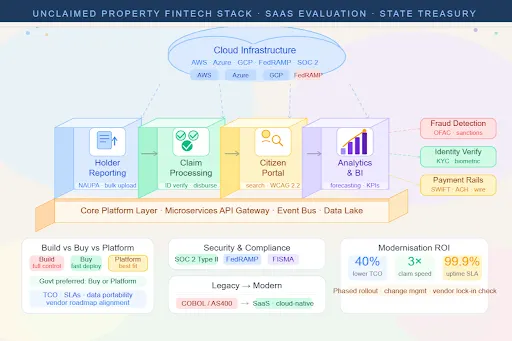
The state treasuries are finding themselves more often in a technological cross road. Decades of unclaimed property activities have been based on legacy mainframe systems, which are usually on older COBOL or AS/400-based architectures, lack scalability, and can hardly be integrated with newer digital services at all. Modernization has ceased to be an option with the growing demands of the people, propelled by the easy services of the banking industry in the private sector.
The movement to Software-as-a-Service (SaaS) and cloud-native fintech solutions provides a way to go. The new systems offer lower infrastructure, automatic security patches, and scalability that would be necessary to handle billions of dollars of assets. The government technology acquisition is however infamously complicated. The proper choice of the so-called fintech stack presupposes a stringent analysis of the functional possibilities, the technical system, and the sustainability of the vendor. This paper offers an objective model on assessing vendors of unclaimed property to make sure that state agencies purchase solutions that will create enduring value to the populace.
The Unclaimed Property Technology Landscape
The current market for unclaimed property technology is diversifying rapidly. The landscape has always had a few enterprise players, but now boasts new fintech startups and point solutions that target a particular part of the lifecycle, like holder reporting or fraud detection.
Government CIOs need to decide whether to use a complete “all-in-one” platform or a best-of-breed strategy that incorporates many specialized tools. All types of the stack have an important purpose:
- Holder Reporting Systems: Facilitating online filing, bulk uploads, and NAUPA-compliant validation.
- Claim Processing Platforms: The management of workflow starting with the submission of a claim to the identification of an individual to disbursement.
- Search and Reunification Portals: The interface that offers citizens access to their property searching and reclaiming.
- Analytics and BI Tools: Delivering the insights needed for budget forecasting and compliance monitoring.
As highlighted in recent GovTech industry analysis, the move to the cloud allows agencies to shift from heavy capital expenditures to more predictable operational expense models, significantly lowering the total cost of ownership (TCO) over time.
Evaluation Framework and Criteria
A rigorous evaluation begins with a clear separation of functional and technical requirements. A solution may have a sleek user interface but lack the underlying security architecture required for government data sovereignty.
Functional Requirements
The platform must support the full NAUPA standard for holder reporting and offer robust amendment workflows. Claim processing requires the capability to combine with third-party identity verification and fraud detection services, which is paramount. On citizen facing side, the search engine should be enabled to facilitate fuzzy name match and follow the latest WCAG 2.2 standards of accessibility so that all Americans can get their money.
Technical and Security Mandates
This should be ideally a cloud-native (native to AWS, Azure or GCP) implementation and should be architected as a microservices system so that an update to one bit of code does not bring the whole system to a halt. The cornerstone is security, vendors should prove their SOC 2 Type II-certified and, where possible, conform to FedRAMP or FISMA regulations. Data residency and portability are also important- agencies need to be sure that they can move their data easily in case they decide to switch vendors in future. Extensive software selection practices underline the idea that technical strength is as relevant as the richness of features is.
Vendor Assessment and Due Diligence
After the requirements are stipulated, then it is the turn of the stability of the operations of the vendor. In the fintech world, company longevity and funding status are leading indicators of whether a vendor will be around to support a ten-year contract.
When considering a treasury technology platform, state procurement teams need to consider the richness of features versus the complexity of implementation and make certain that the solution chosen can support expansion over time since the first implementation through decades of implementation. Due diligence is to involve a lot of customer reference checks and visits on existing deployments. Another important thing is to examine the vendor product roadmap- does their vision of the future of unclaimed property meet your long-term strategic objectives of the agency?
Cost Structure and SLAs
In addition to the initial implementation cost, procurement officers should consider the annual maintenance, training, and possible customization. The response times of critical issues should be clearly stated in Service Level Agreements (SLAs) and uptime percentages ensured. A vendor that is unable to promise high availability poses a big threat to a service facing the world.
Build vs. Buy vs. Platform Decision
The question of creating a custom solution to build or purchasing a commercial off-the-shelf (COTS) product or adopting a modular platform are one of the most important strategic decisions.
- Build: Full control but very expensive, lengthy schedule and permanent in-house maintenance.
- Buy: Rapidly deployable and has demonstrated functionality but may need the agency to adapt its processes to meet the software constraints.
- Platform: Often represents the “best of both worlds,” providing a core set of features with the extensibility to add custom modules or integrate third-party tools.
According to technology strategy frameworks, the “Buy” or “Platform” approach is generally preferred for government agencies unless the requirements are so unique that no market solution exists. Common mistakes in this phase include over-engineering requirements or ignoring the “change management” costs associated with moving staff to a new system.
Implementation and Change Management
The implementation process can make or break a new fintech stack, rather than the code. A staged migration is generally safer as compared to a big bang migration. This starts with a discovery stage to test requirements, then data migration; a stage that needs careful mapping to maintain data integrity between the old system and new platform.
Change management is the human side of the equation. It entails active stakeholder communications, extensive staff training, redesigning of business processes to exploit the automation features of the new system. Strong executive sponsorship and partnership outlook with the vendor are some of the success factors. Agencies should also have a feedback loop after implementation to track feature adoption and assess the ROI of the modernization project.
Read More: Zavalio.com Review: Website Features, Content Categories, Benefits and Limitations
Conclusion
The decision to modernize an unclaimed property program is a strategic investment in the state’s financial future. Although converting the legacy systems into a modern fintech stack is a complicated process, the advantages of efficiency and security improvement, as well as the better citizen service, are immense. The legacy systems should not shackle back your program, and with careful consideration of a comprehensive evaluation framework and emphasis on long-term scalability, state treasuries can make their operations a model of a digital government. The appropriate technology will allow to serve citizens in a better way, and make sure that more money is returned to their owners in a safe, transparent and user-friendly process.