
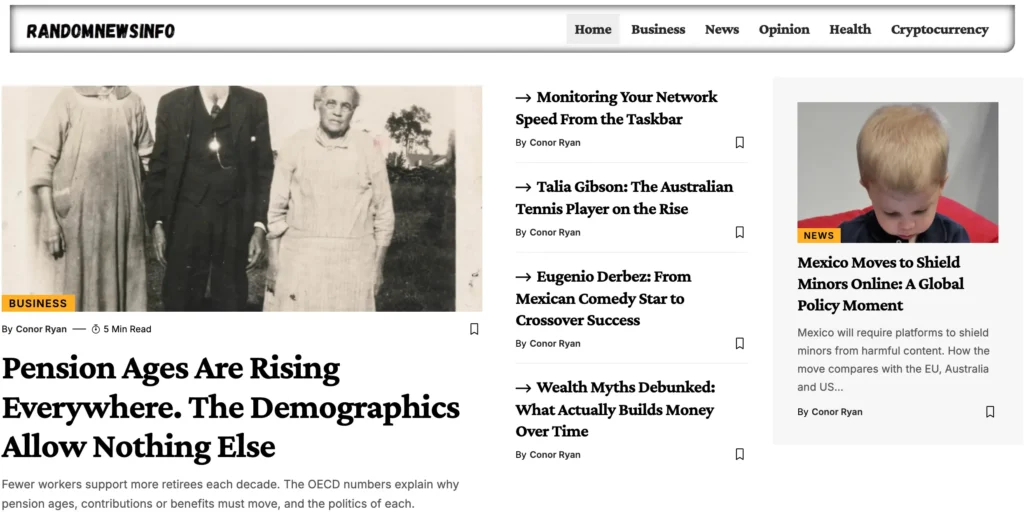
The internet has transformed how people discover news, explore business developments, and learn about changing trends around the world. Readers can now access information about finance, health, technology, digital currencies, and current affairs from a wide range of online publications. General-interest news websites make it possible to explore several subjects without relying on a single category of information.
RandomNewsInfo is an online information and publishing website that covers subjects such as business, news, opinion, health, and cryptocurrency. Its broad editorial focus is intended for readers who want to explore different topics, discover new perspectives, and stay informed about developments across multiple industries.
A general-interest website can be useful when readers want to browse different subjects in one place. However, the quality of the experience depends on the relevance of its articles, the clarity of its writing, the accuracy of its information, and how transparently it presents its sources.
This review examines the website’s content categories, reading experience, potential benefits, limitations, and practical considerations for readers who use online information platforms.
What Is RandomNewsInfo?
RandomNewsInfo is a digital publishing platform that presents articles and informational content across several subject areas. Its stated focus includes business developments, general news, health-related topics, cryptocurrency, and opinion pieces.
Rather than concentrating exclusively on one specialist industry, the website offers a broader range of subjects that may appeal to readers with different interests. Someone researching a business trend may also want to explore a health article or read about developments in the cryptocurrency market.
The website’s general-interest approach can make it a starting point for discovering unfamiliar subjects. Readers can browse available categories, identify topics that interest them, and use relevant articles as a basis for further research.
It is important, however, to distinguish between introductory information and verified specialist advice. Articles about financial markets, health, or major news events should be assessed according to the evidence they provide and the reliability of their sources.
Main Content Categories
A news and information website becomes easier to navigate when its content is divided into clear categories. Topic-based organization helps readers find relevant material and understand the general focus of individual articles.
1. Latest News and Current Affairs
News coverage helps readers learn about developments affecting communities, industries, governments, and international affairs.
Articles in this category may discuss current events, emerging stories, public announcements, and other subjects attracting attention. Readers often use online news platforms to obtain an initial overview of a topic before consulting additional reporting.
When reading current-affairs content, it is useful to check the publication date, identify the original source of a claim, and determine whether the article distinguishes confirmed facts from speculation.
Readers should also compare important claims with independent reporting, especially when a story concerns public safety, elections, major financial developments, or other consequential issues.
2. Business and Entrepreneurship
Business information can help readers understand companies, markets, entrepreneurship, and changes in the commercial environment.
Common business subjects include:
- Small-business development
- Entrepreneurship and startup ideas
- Company announcements
- Industry trends
- Consumer behaviour
- Marketing and digital business
- Economic developments
- Productivity and management
Entrepreneurs may find general business articles useful when exploring new ideas or learning about challenges that businesses commonly face.
For example, a reader researching digital marketing may want to understand how customer behaviour, online visibility, and changing technology influence business growth. An introductory article can provide context before the reader examines specialist research or industry data.
Business content should not be treated as a guarantee of commercial success. Results depend on many factors, including market conditions, available resources, competition, and the quality of business decisions.
3. Health and Well-Being
Health is another subject covered by general-interest publishing websites. Articles in this area may discuss everyday wellness, healthy routines, fitness, medical developments, and other topics related to personal well-being.
Health information can help readers prepare questions, understand common terminology, and become more familiar with general wellness concepts.
However, health advice requires particular care because information that applies to one person may not be appropriate for another.
Readers should consider the author’s qualifications, the date of publication, the quality of the supporting evidence, and whether the article refers to recognized medical sources. Claims about treatments, medications, or medical conditions should be checked with qualified healthcare professionals.
General wellness articles can support learning, but they should not replace professional assessment, diagnosis, or treatment.
4. Cryptocurrency and Digital Currency
Cryptocurrency is a fast-changing area of digital finance. It includes blockchain technology, digital assets, cryptocurrency exchanges, market activity, and developments involving financial technology.
Articles in this category may help readers understand concepts such as:
- What cryptocurrencies are
- How blockchain networks operate
- How digital wallets work
- The role of cryptocurrency exchanges
- Market volatility
- Common digital-asset risks
- Cryptocurrency regulations
- Security and fraud prevention
For beginners, introductory explanations can make unfamiliar terminology easier to understand.
Nevertheless, cryptocurrency markets can be highly volatile, and digital-asset transactions may involve substantial financial risk. A published article should not be interpreted as a promise of investment returns.
Readers should verify market figures through reliable sources, investigate the risks of any financial product, and be cautious of guaranteed-profit claims or pressure to invest quickly.
5. Opinion and Analysis
Opinion articles provide commentary on events, public issues, industry developments, and social trends. They can introduce alternative viewpoints and encourage readers to examine a topic from more than one perspective.
A well-presented opinion piece should make its position clear and provide enough reasoning for readers to understand the author’s argument.
It is also important to distinguish opinions from factual reporting. A persuasive argument does not automatically establish that every claim within it is accurate.
Readers can evaluate opinion content by asking whether it presents supporting evidence, acknowledges relevant context, and fairly represents differing perspectives.
Comparing multiple viewpoints can help readers develop a more balanced understanding of complicated issues.
6. Technology and Digital Trends
Technology influences business, education, communication, entertainment, and everyday life. General-interest publications may also discuss digital developments that affect these areas.
Potential subjects include artificial intelligence, online services, digital marketing, cybersecurity awareness, software tools, and changes in how people use the internet.
Technology articles can be especially useful when they explain technical ideas in accessible language.
Readers should still verify claims about new products, software features, security vulnerabilities, and product availability through official documentation or trusted technical publications.
Because technology changes quickly, an older article may contain details that are no longer accurate.
Website Navigation and Reading Experience
The structure of a publishing website influences how easily visitors can find and understand its content. Clear navigation is particularly important for platforms covering several unrelated subjects.
When evaluating the user experience, readers can consider the following factors.
Category organization: Separate sections for news, business, health, opinion, and cryptocurrency help users identify relevant articles.
Search functionality: A useful search feature can help visitors locate a particular topic or article without browsing every category.
Readable formatting: Short paragraphs, descriptive headings, and clear language make longer articles easier to follow.
Mobile compatibility: Responsive pages allow readers to access information on smartphones, tablets, and desktop computers.
Article dates: Publication and update dates help visitors determine whether information may be outdated.
Source transparency: Clear references and links to original material allow readers to investigate important claims.
These are useful criteria for evaluating any online publication. Individual pages may differ in their structure, detail, and overall usefulness.
Read More: BlogBuzzNews Review: News, Technology, Business, and Lifestyle Insights
Potential Benefits for Readers
A general-interest publishing website can offer several advantages when its content is relevant, clear, and appropriately supported.
Exploring Multiple Topics
Readers do not always want information from a single specialist category. A broad website makes it possible to move between business, current affairs, health, and digital finance according to changing interests.
This flexibility can be useful for people who enjoy learning about different industries and developments.
Discovering New Subjects
An article about an unfamiliar topic may encourage readers to investigate a subject they have not previously explored.
For example, someone reading about business growth might become interested in digital marketing, while a reader exploring technology could begin learning about blockchain systems.
Building General Knowledge
Accessible articles can introduce key concepts and explain terminology. This may help readers understand discussions they encounter in professional settings, news coverage, or everyday life.
Supporting Further Research
Introductory content can provide useful background before readers move to more detailed sources, official reports, academic publications, or specialist websites.
The most valuable use of general-interest articles is often as a starting point rather than the final authority on a complicated subject.
Convenient Online Access
Web-based publishing allows readers to explore information at a convenient time, provided they have an internet connection and a compatible device.
This makes online articles a practical option for readers who prefer self-directed learning.
Content Quality and Reliability
The number of articles published by a website is not the only measure of its value. Accuracy, originality, relevance, and editorial transparency are also important.
Readers should examine several aspects of an article before relying on its claims.
Accuracy of Information
Factual statements should be supported by evidence where appropriate. Dates, statistics, quotations, and claims about events should be checked against dependable sources.
Author Information
Author names and relevant qualifications can help readers understand who created an article and whether the writer has expertise in the subject.
For specialist topics, professional experience may be particularly important.
Originality and Depth
Useful articles should provide meaningful explanations rather than simply repeating generic statements. Clear examples, relevant evidence, and well-developed arguments can improve their value.
Publication Dates
News, cryptocurrency, health, and technology content can become outdated. Readers should pay attention to when an article was published and whether it has been updated.
Editorial Transparency
A clear distinction between news reporting, opinion, advertising, and sponsored material helps readers understand the purpose of an article.
These checks are useful for assessing individual pages. A website’s broad subject coverage alone does not establish that every article meets the same quality standard.
Online Safety and Responsible Information Use
Reading online articles is generally straightforward, but users should remain aware of privacy, misleading claims, and suspicious links.
Check Links Before Opening Them
Before visiting an unfamiliar external link, examine the destination where possible. Avoid links that redirect repeatedly, imitate well-known services, or request unnecessary personal information.
Protect Personal Information
Readers should be cautious when a website requests sensitive information unrelated to the content they want to access.
Avoid sharing passwords, banking credentials, payment details, or one-time verification codes with unfamiliar services.
Be Careful With Financial Claims
Cryptocurrency and investment articles may discuss products or opportunities that involve financial risk. Promises of guaranteed returns, urgent investment requests, and unexplained claims of exceptional profits should be treated with caution.
Independent research is essential before making financial decisions.
Verify Health Information
Readers should check medical claims through qualified professionals and reliable healthcare sources. Do not change medication or treatment based only on a general online article.
Identify Sponsored Content
Some online articles may include advertising, promotional links, or sponsored material. Understanding these relationships can help readers distinguish independent information from commercial messaging.
Use Updated Software
An updated browser and operating system can help reduce exposure to known security vulnerabilities. Readers should also avoid downloading unfamiliar files simply because an article recommends them.
These precautions support safer browsing across the internet and are not claims that a particular website has experienced a security incident.
How to Evaluate News Articles
News articles can influence how readers understand public events, business developments, and social issues. A careful reading process can help reduce the risk of accepting incomplete or misleading information.
First, identify the central claim. Determine what the article is actually reporting and whether the headline accurately reflects the body of the story.
Second, check the publication date. An old story may be shared again without enough context, making a past event appear current.
Third, examine the evidence. Look for direct statements, official documents, named sources, relevant data, and links to original reporting.
Fourth, compare independent coverage. If a story is important, see whether other established publications report the same core facts.
Finally, distinguish confirmed information from commentary. An article may include interpretation alongside factual reporting, and readers should understand the difference.
These habits are useful whether someone is reading a major international story, a business announcement, or a report about a new digital trend.
Who May Find the Website Useful?
The website’s broad subject range may appeal to several types of readers.
- General readers: People who enjoy exploring different subjects and learning about current topics.
- Business owners: Entrepreneurs looking for introductory information about companies, marketing, and industry developments.
- Students: Learners who want accessible background information before conducting more detailed research.
- Technology enthusiasts: Readers interested in digital developments and changing online services.
- Cryptocurrency beginners: People seeking introductory explanations of blockchain and digital assets.
- Health-conscious readers: Individuals interested in general wellness information, provided they verify medical claims appropriately.
- Readers interested in commentary: People who want to explore opinions and perspectives on current issues.
The usefulness of any article depends on its relevance to the reader’s needs, the quality of its information, and whether the subject requires more authoritative specialist guidance.
Visit our blog to get more information: https://techsslaash.co/blogs/
Tips for Getting More Value From Online Publishing Websites
Readers can improve their research process by following a few simple practices.
- Choose a clear topic. Identify the question you want an article to answer before browsing.
- Use category pages. Topic-based navigation can make it easier to find relevant material.
- Check publication dates. Confirm that the information is recent enough for your purpose.
- Follow original sources. When an article refers to a report, announcement, or study, look for the original document.
- Compare important claims. Use more than one reliable source when researching significant news or complicated issues.
- Separate fact from opinion. Consider whether a statement is supported by evidence or represents an interpretation.
- Verify specialist advice. Use qualified medical, legal, or financial professionals when decisions require expert guidance.
- Keep security in mind. Avoid suspicious downloads and requests for unnecessary personal details.
For journalistic standards and an example of how a major news organization describes its reporting principles, readers can consult the Associated Press News Values and Principles.
Frequently Asked Questions
What is RandomNewsInfo?
RandomNewsInfo is an online publishing website covering several subject areas, including business, general news, health, opinion, and cryptocurrency.
What topics can readers explore?
The site’s stated categories include business insights, news updates, health-related information, cryptocurrency, and opinion articles. The available material may change over time.
Is the website focused on one particular industry?
No. Its stated editorial approach covers several subjects rather than focusing exclusively on a single specialist industry.
Can readers use online news articles for research?
Articles can provide introductory context and help readers identify subjects for further investigation. Important claims should be checked against reliable sources, original documents, or specialist publications.
Should cryptocurrency articles be treated as investment advice?
No. General articles can explain concepts and market developments, but cryptocurrency involves financial risks. Readers should conduct independent research and consider qualified financial advice when appropriate.
Is general online health information enough to make medical decisions?
Not necessarily. Health articles can provide background information, but individual medical concerns should be discussed with a qualified healthcare professional.
How can readers judge whether an article is reliable?
Check its author, publication date, evidence, references, transparency, and consistency with independent reporting. For important claims, consult original or authoritative sources.
Why do publication dates matter?
Information about news, finance, health, and technology can change quickly. A publication date helps readers assess whether an article remains relevant and accurate.
Final Verdict
RandomNewsInfo offers a broad publishing approach that brings together news, business, health, opinion, and cryptocurrency topics. This range may suit readers who want to explore different subjects and use general-interest articles to discover ideas or begin researching unfamiliar topics.
Its potential value depends on the quality of individual articles, the accuracy of their claims, the clarity of their presentation, and the transparency of their sources. Readers should not assume that every article is equally authoritative, especially when it concerns health, financial decisions, or rapidly developing news.
Overall, the website can serve as a starting point for general information and topic discovery. For important decisions, readers should verify claims through trusted sources and consult qualified professionals when necessary. A careful approach to online research helps readers benefit from digital publishing while maintaining a healthy level of skepticism.