
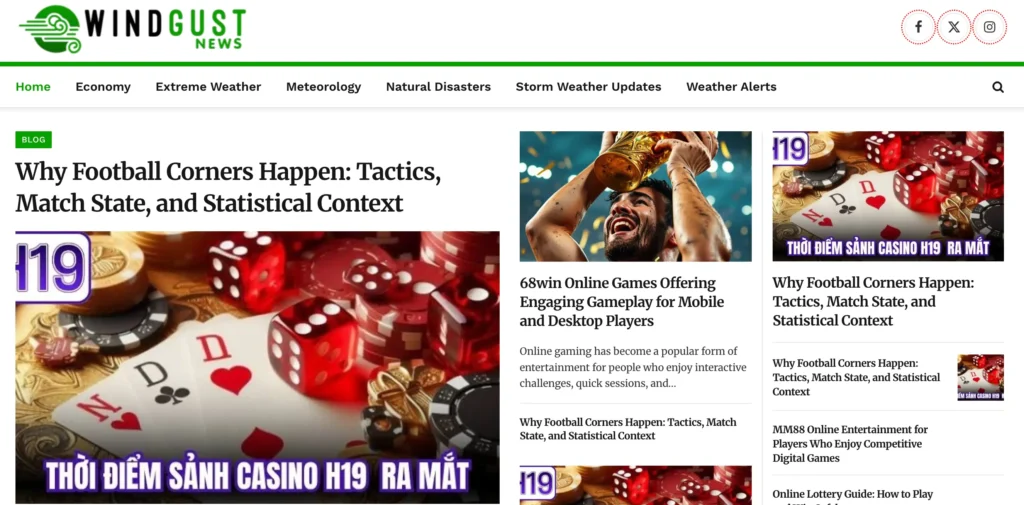
Weather conditions can change quickly, affecting daily routines, outdoor activities, road travel, and public safety. Strong winds, sudden storms, and changing temperatures can create challenges for individuals, families, and businesses. Access to clear and timely information helps people understand changing conditions and make better-informed decisions.
WindGustNews is an online publishing website that presents itself as a source of weather information, wind reports, storm updates, forecasts, and safety guidance. Its blog also features broader subjects, including technology, online entertainment, business, and other informational topics.
This combination gives readers an opportunity to explore weather-related information alongside general-interest articles. However, weather conditions are location-specific and can change rapidly, so readers should always verify urgent warnings and forecasts through authoritative meteorological services.
This article explores the website’s stated purpose, its potential content categories, the importance of weather reporting, practical safety considerations, and ways to evaluate online information.
What Is WindGustNews?
WindGustNews is a digital publishing platform associated with weather-related information and general online articles. Its official About Us page describes a focus on wind gust reports, weather alerts, forecasts, storm conditions, educational resources, and safety tips.
The website aims to make weather-related information accessible to readers who want to learn about wind conditions and their possible effects on everyday life.
Wind gusts are particularly important because wind speed does not always remain constant. A relatively calm period can be interrupted by a short burst of stronger wind, potentially affecting people outdoors, vehicles, trees, temporary structures, and exposed property.
The website’s broader blog content also includes topics beyond meteorology. Readers may encounter articles about technology, digital entertainment, business, lifestyle, and other online subjects.
As with any digital publication, readers should assess individual articles according to their accuracy, relevance, publication date, and supporting evidence rather than assuming every page offers the same level of authority.
Main Content Categories
1. Weather Updates and Forecasts
Weather forecasts help people prepare for expected conditions over a particular period. Information about temperature, rainfall, wind direction, and wind speed can support decisions about commuting, outdoor activities, travel, and event planning.
Useful weather reporting should clearly identify the location and time period covered by a forecast. A forecast for one city may not apply to a nearby coastal area, mountain region, or open countryside.
When reading weather-related content, consider whether it includes:
- The location covered by the forecast.
- The date and time of the reported conditions.
- Expected wind speeds and directions.
- Possible rainfall, thunderstorms, or other hazards.
- The source of the forecast data.
- Any relevant warning or advisory information.
WindGustNews presents weather forecasts as one of its intended content areas. Readers who need current conditions should confirm the information with an official weather service, especially before making decisions that depend on accurate forecasts.
2. Wind Gust Reports
Wind gusts are brief increases in wind speed that can be considerably stronger than the surrounding average wind. Understanding the difference between sustained wind and gusts is important when evaluating weather conditions.
For example, an average wind speed may appear manageable while occasional stronger gusts create difficulties for cyclists, pedestrians, high-sided vehicles, or people working at height.
Wind gust reports can be relevant to several everyday situations.
Outdoor activities: Strong gusts may affect hiking, camping, cycling, sports, and outdoor events.
Road travel: Sudden crosswinds can affect vehicle stability, particularly for motorcycles, buses, trucks, and vehicles carrying large loads.
Property maintenance: Loose outdoor furniture, unsecured equipment, and temporary structures may become hazardous in strong winds.
Coastal activities: Wind can contribute to rough sea conditions and make activities near the water more dangerous.
Construction work: Exposed worksites may require additional precautions when wind speeds increase.
Wind reports are most useful when they provide clear measurements, timestamps, and location information. Readers should avoid treating a general article as a substitute for a current local warning.
3. Storm Information and Weather Alerts
Storms can bring several hazards, including strong winds, lightning, heavy rainfall, flooding, and falling branches. The risks vary depending on the type of storm, local geography, and the strength of the weather system.
Weather alerts are designed to communicate potential hazards and help people take appropriate precautions.
When evaluating a storm update, readers should look for the affected areas, the expected timing, the severity of the threat, and any recommended actions. They should also check whether the information comes from an official meteorological or emergency-management authority.
A useful storm article should explain the situation in straightforward language without exaggerating the threat or presenting unconfirmed reports as established facts.
WindGustNews identifies storm updates and weather alerts as part of its intended focus. Nevertheless, readers should check official warning channels for urgent, location-specific information because online articles may not update at the same speed as emergency alerts.
Read More: https://techsslaash.co/blogbuzznews/
4. Weather Education and Meteorology
Weather education helps readers understand why atmospheric conditions change and how those changes influence the environment.
Meteorology is the scientific study of the atmosphere, including weather systems, wind patterns, precipitation, and forecasting.
Introductory educational articles may explain subjects such as air pressure, temperature differences, wind direction, cloud formation, and the development of storms.
Understanding these concepts can help readers interpret forecasts more effectively.
For example, differences in air pressure contribute to wind, while local terrain and buildings can influence how air moves through a particular area. Coastal locations, open plains, and elevated regions can experience different wind patterns even when they are affected by the same broader weather system.
Educational content is especially useful when it combines accessible explanations with reliable scientific information. Readers should be cautious of articles that make sweeping claims about weather or climate without providing evidence.
5. Weather Safety Tips
Weather safety information helps people prepare for conditions that could affect their health, property, or travel.
Strong winds can cause flying debris, damage to roofs, fallen branches, and hazardous conditions around temporary structures. Preparation can reduce some risks, although no precaution can eliminate every danger.
Practical safety measures include securing loose outdoor objects, avoiding damaged trees and structures, checking local weather warnings, and postponing exposed outdoor activities when authorities advise against them.
Drivers should be particularly careful when travelling in strong crosswinds. Reducing speed, keeping additional distance from other vehicles, and avoiding unnecessary journeys during severe conditions can improve safety.
People should also understand the limits of general online guidance. The safest action depends on the specific hazard, local conditions, and advice from emergency services.
For more detailed guidance, readers can consult the U.S. National Weather Service’s Wind Safety information, which explains wind-related hazards and recommended precautions.
6. Technology and General News
Although the website’s stated identity emphasizes weather, its blog includes broader informational material. This can introduce readers to topics outside meteorology.
Technology articles may discuss digital tools, cybersecurity awareness, online platforms, artificial intelligence, and changes in how people communicate or work.
General news and informational articles can also help readers discover new subjects and identify topics for further research.
However, different subjects require different standards of verification. A general technology article should be evaluated for technical accuracy, while a weather warning requires current location-specific information.
Readers should also distinguish between reporting, commentary, sponsored material, and promotional content.
Why Wind Gust Information Matters
Wind gusts can affect daily life in ways that are not always obvious from a standard weather forecast.
Effects on Transportation
Strong crosswinds can make driving more challenging, especially on exposed roads, bridges, and open highways. High-sided vehicles may be more vulnerable because wind can exert greater force on their larger surface area.
Motorcyclists and cyclists may also find it harder to maintain balance when sudden gusts occur.
Checking weather conditions before a journey can help travellers anticipate potential difficulties and adjust their plans when necessary.
Effects on Homes and Buildings
High winds can damage roof materials, fences, outdoor equipment, and unsecured objects. Flying debris may also create hazards for people nearby.
Before strong winds arrive, property owners can inspect outdoor areas, secure lightweight items, and follow official advice about preparing buildings.
People should avoid climbing onto roofs or attempting dangerous repairs during severe weather.
Effects on Outdoor Events
Sports matches, festivals, markets, and other outdoor activities can be affected by wind. Temporary structures, tents, signs, and equipment may become unstable under stronger gusts.
Event organizers should monitor forecasts and follow professional safety guidance when deciding whether an activity can proceed.
Effects on Coastal and Open Areas
Coastal locations and open landscapes may experience strong winds with fewer natural barriers. Wind conditions can also influence waves and other hazards around the water.
Visitors should check local warnings before swimming, boating, hiking, or participating in other exposed activities.
How to Evaluate Weather Information Online
Online weather information can be convenient, but not every article provides the same level of accuracy or timeliness.
Check the Source
Look for information about where the forecast or measurement originated. Official meteorological agencies and recognized forecasting services are generally preferable for urgent weather decisions.
Confirm the Location
Weather varies significantly across relatively short distances. Make sure the information applies to the area you intend to visit.
Review the Timestamp
A forecast or wind measurement without a clear timestamp may be difficult to interpret. Conditions can change between the time an article is published and the time it is read.
Understand the Measurements
Wind speed may be reported in kilometres per hour, miles per hour, metres per second, or knots. Check the units before comparing figures from different sources.
Also distinguish between average wind speed and maximum gust speed.
Compare Important Information
When severe weather is possible, compare reports with official warnings and local emergency guidance. Do not rely on a single general-interest article for critical safety decisions.
Avoid Sensational Headlines
Dramatic headlines can attract attention without accurately representing the actual level of risk. Read the full report and look for evidence supporting its claims.
Website Navigation and Reading Experience
The usefulness of a publishing website depends partly on how easily readers can find relevant information.
A clear navigation structure allows visitors to move between weather information, safety guidance, educational content, and general-interest articles.
When assessing WindGustNews, readers may consider the following factors:
- Clear categories: Topics should be organized in a way that makes relevant content easy to locate.
- Readable articles: Descriptive headings and concise paragraphs improve comprehension.
- Mobile compatibility: Pages should remain readable on smartphones and tablets.
- Updated information: Weather-related content should clearly indicate when it was published or updated.
- Source transparency: Important claims should be supported by identifiable sources.
- Accessible language: Technical weather concepts should be explained for readers without specialist knowledge.
These are useful evaluation criteria rather than guarantees about every page’s design or performance.
Potential Benefits for Readers
A website covering weather and general-interest topics can provide several potential benefits when its content is relevant and appropriately sourced.
Convenient Information Discovery
Readers can explore different subjects through an online publishing platform without relying entirely on printed material.
Greater Weather Awareness
Educational articles can help readers understand the meaning of wind gusts, weather warnings, and other meteorological terms.
Practical Preparation
General safety information may encourage readers to check conditions before travelling or planning outdoor activities.
Broader Learning
Technology and general-interest articles can introduce readers to new topics and provide background for further research.
Support for Everyday Planning
Weather information can be useful when deciding whether to exercise outdoors, travel, arrange an event, or undertake certain property-maintenance tasks.
These benefits depend on the accuracy and timeliness of the information. Readers should use current authoritative forecasts for decisions involving safety.
Read More: https://techsslaash.co/randomnewsinfo/
Limitations to Keep in Mind
Every online information source has limitations, and readers should understand these before relying on its content.
Forecasts can change. Weather predictions are based on available observations and forecasting models. Conditions may develop differently from expectations.
Coverage may vary by location. An article about one region may not provide useful information for another.
Publication delays are possible. A blog article may not reflect the latest warning or measurement.
General advice may not cover every situation. Local conditions, individual circumstances, and official instructions can affect which precautions are appropriate.
Different topics require specialist knowledge. Readers should verify technical, medical, financial, or safety-related claims with relevant authoritative sources.
WindGustNews describes its intended focus as weather information and related safety guidance, but readers should independently verify time-sensitive information rather than assume that every article is an official forecast.
Who May Find WindGustNews Useful?
The website’s stated weather focus and wider blog content may appeal to several audiences.
- Everyday readers: People interested in general information and changing weather conditions.
- Outdoor enthusiasts: Hikers, cyclists, campers, and sports participants who need to consider wind and weather risks.
- Travellers: People who want to understand weather-related factors before planning a journey.
- Homeowners: Individuals interested in preparing outdoor spaces for strong winds.
- Students: Learners exploring basic meteorology and environmental topics.
- General-interest readers: Visitors who enjoy browsing technology and other informational articles.
For anyone facing severe weather, official local forecasts and emergency alerts should remain the primary sources for decisions about immediate safety.
Frequently Asked Questions
What is WindGustNews?
WindGustNews is an online publishing website that describes its focus as wind reports, weather forecasts, storm information, educational resources, and safety guidance.
What topics does the website cover?
Its stated focus includes wind gusts, weather alerts, forecasts, storm conditions, and safety tips. Its blog also contains general-interest subjects such as technology and online entertainment.
Why are wind gust reports important?
Wind gusts can briefly exceed the average wind speed and may affect transportation, outdoor activities, buildings, and temporary structures.
Can an online article replace an official weather warning?
No. General articles may provide background information, but readers should consult official local meteorological services and emergency authorities for current warnings.
How can readers prepare for strong winds?
Secure loose outdoor objects, check official forecasts, avoid exposed or damaged structures, and follow local safety instructions. Postpone hazardous outdoor activities when authorities recommend doing so.
Are weather forecasts always accurate?
No forecast can guarantee the exact conditions that will occur. Forecasts are updated as new observations and information become available, so readers should check the latest reports.
Does the website cover topics beyond weather?
Yes. Its blog includes general-interest articles on additional subjects, although the range and focus of published material can change over time.
How can readers check whether weather information is current?
Check the publication timestamp, confirm the relevant location, and compare the information with an official weather service.
Final Verdict
WindGustNews presents itself as a digital source for weather-related information, including wind gust reports, forecasts, storm updates, and safety guidance. Its blog also offers broader informational content, giving readers opportunities to explore topics beyond meteorology.
The website may be useful for discovering weather concepts and reading general educational material. Its value for time-sensitive decisions, however, depends on whether the information is current, location-specific, and supported by reliable sources.
Readers should confirm urgent warnings through official meteorological services, pay attention to publication dates, and follow local emergency guidance during severe weather.
Overall, WindGustNews can serve as a starting point for exploring weather and general-interest information, while authoritative forecasts remain essential for decisions that affect personal safety.